
How to recognise genuine “Premium” olive oil: a science-based analysis of our “Picual”
Picual olive oil is known as one of the most stable and polyphenol-rich olive varieties. Yet many bottles of extra virgin ( Extra Virgin) olive oil on shop shelves promise flawless quality. The true value of an oil is defined not by its label design, but by its chemical composition and independent laboratory tests.
For full transparency, we present test data from the Spanish laboratory CM Europa S.L. on our “Picual” olive oil (batch “Depósito B11”). The laboratory is accredited by the Spanish national accreditation body ENAC to the ISO 17025 standard (accreditation No. 585/LE1139). It is also registered with the Andalusian regional Ministry of Agriculture as an official control laboratory.
The limit values we compare the results with are set out in Commission Delegated Regulation (EU) 2022/2104, which defines the olive oil categories.
What makes Picual olive oil special?
“Picual” is the most widely grown olive variety in Spain, especially in the province of Jaén, home to the Cazorla region. Oil from this variety has an intense fruity flavour, natural bitterness and high resistance to oxidation. As a result, Picual olive oil keeps its freshness and valuable properties for longer.
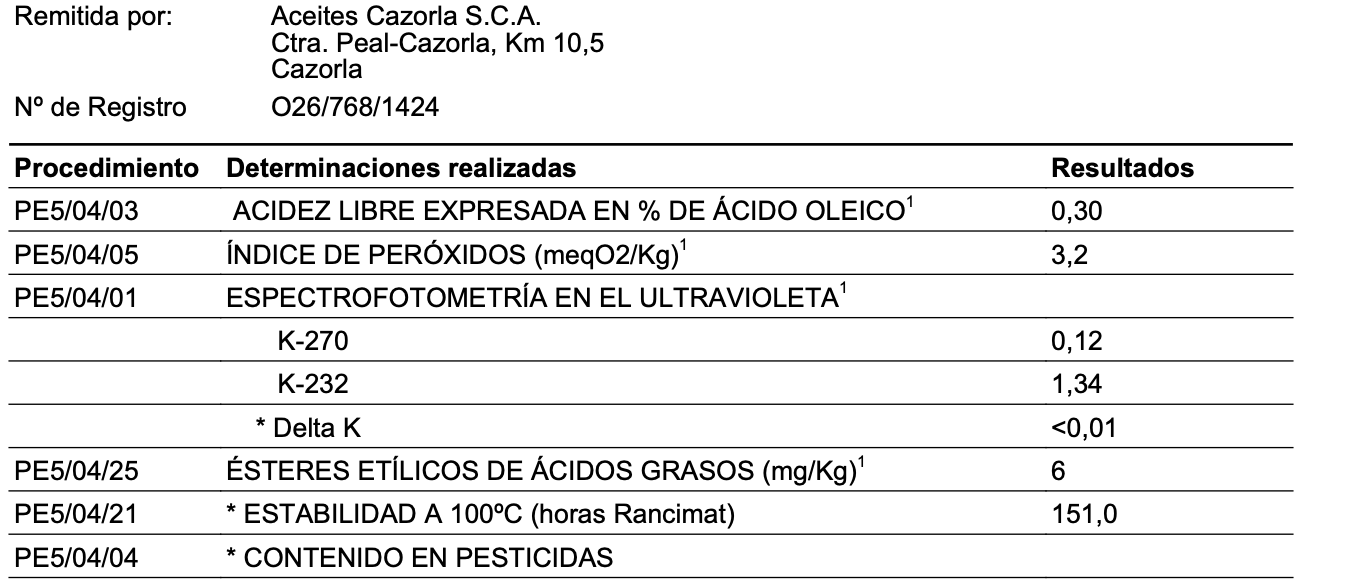
1. Free acidity: 0.30%
- Extra virgin limit: no more than 0.80%
- Our oil’s result: 0,30 %
Free acidity reflects the condition of the fruit before pressing. If olives are damaged, have fallen to the ground or waited too long to be processed, decomposition begins and acidity rises. A result of 0.30% shows that the oil was pressed from healthy olives that were processed quickly.
2. Peroxide value: 3.2 meq O₂/kg
- Extra virgin limit: no more than 20 meq O₂/kg
- Our oil’s result: 3.2 meq O₂/kg
The peroxide value shows the oil’s freshness and early oxidation. The lower it is, the fresher the product. A value of 3.2 is more than six times lower than the permitted limit. This shows that the oil has been properly protected from light, heat and oxygen.
Additional oxidation and authenticity indicators
| Indicator | Extra virgin limit | Our oil |
|---|---|---|
| K-232 (UV absorbance) | ≤ 2,50 | 1,34 |
| K-270 (UV absorbance) | ≤ 0,22 | 0,12 |
| ΔK | ≤ 0,01 | < 0,01 |
| Fatty acid ethyl esters | ≤ 35 mg/kg | 6 mg/kg |
A low ethyl ester content is especially important: it shows that the oil was made from healthy, unfermented fruit and has not been blended with lower-quality oils.
3. Oxidative stability (Rancimat): 151.0 hours
The Rancimat method measures how long an oil withstands accelerated oxidation at 100 °C. The longer, the more resistant the oil is to ageing. A result of 151 hours is very high. It comes from a high concentration of natural antioxidants, above all polyphenols. The laboratory also highlights the oil’s high stability in its conclusions.
How to recognise polyphenols by tasting?
When you taste a teaspoon of this oil, after a moment you’ll feel a slight bitterness and a pungency that tickles your throat. Many buyers think bitterness is a flaw, but the opposite is true. The International Olive Council (IOC) considers bitterness and pungency to be positive attributes of extra virgin oil. These sensations are caused by polyphenols such as oleocanthal. Polyphenols act as antioxidants that protect the oil itself from spoiling, and scientific research links them to health benefits.
4. Purity and sensory assessment
Pesticides. Of the 128 pesticide compounds tested, none were found above the laboratory’s limit of quantification (0.01 mg/kg).
Tasting panel assessment. The oil was assessed by the laboratory’s expert tasting panel using the IOC sensory assessment method (COI/T.20/Doc. No. 15). Result: extra virgin (Virgen Extra).
| Attribute (median, scale 0–10) | Result |
|---|---|
| Fruitiness | 4,6 |
| Defects | 0 |
| Bitterness | 3,8 |
| Pungency | 4,2 |
The panel described the oil as very fruity and slightly bitter, with aromas of grass, fresh olives, almond and tomato, and notes of fig tree and apple.
Conclusion
When choosing olive oil, look for science-based facts rather than nice promises. The top category is no accident. It comes from the right harvest timing, careful work and respect for the product. Our Picual olive oil confirms these facts with independent laboratory data.
Would you like to see the full laboratory reports?
The data in this article comes from two CM Europa S.L. reports: No. O26/768/1424 (chemical analysis and 128-pesticide screening) and No. O26/770/1428 (sensory assessment). We’ll gladly send them to you by email.
You’ll find our “Picual” oil in the cazorlaaliejus.lt online shop.

What is the difference between “Extra Virgin” and “Ypač tyras” olive oil?
And what do these terms on an olive oil bottle really mean?🟢 “Extra Virgin” = “Ypač tyras” – they are the sameMany...
read more
Picual olive oil: what it is and why you should choose it
Picual olive oil is one of the most popular and valuable types of olive oil in the world. It is pressed from...
read more

Good olive oil in 2025: how to recognise real quality
Good olive oil is not only tasty but also good for your health. But how do you tell a truly high-quality product...
read more
High-quality olive oil: how to recognise it and why it's worth choosing
What is truly high-quality olive oil?Truly high-quality olive oil belongs to the extra virgin olive oil category. It's a top-quality product obtained...
read more
Extra virgin olive oil for cooking
Olive oil for cooking – online shop Extra virgin olive oil for cooking – which is best?Extra virgin olive oil for...
read more
How to lower cholesterol without medication
Spanish olive oil online shop Foods that lower cholesterolHow to lower cholesterol without medication? – a question that matters to many...
read more
Can olive oil be stored in the fridge?
Short answer: Yes, it can. In the fridge olive oil will keep longer, but it will thicken and turn cloudy. This is...
read more
Health benefits of olive oil
Olive oil has long been valued for its flavour, but even more for its positive effect on health. Extra virgin olive oil...
read more
Olive oil with ice cream
Ice cream dessert with Royal Premium – Grand Selection olive oilA light, refreshing and surprisingly harmonious combination for those who love trying...
read more